A single IMSI often has more than one PDN connection at once: a default internet APN and an IMS APN, sometimes a third. On S11 those additional PDN connections typically reuse the UE's existing control tunnel. On S5/S8, some traces also reuse the same PGW TEID values on different anchor IP addresses. If an analyser keys a session only on TEID, a dedicated bearer or a Delete Bearer Request lands in the wrong PDN — or the shared tunnel is reported as a collision.
This article is about that attribution problem, the shape Mobile Core documents as RPG-6454, and how Mobile Core Generator 1.19.4 both produces it on purpose and follows Linked EPS Bearer ID / EPS Bearer ID when it reads the capture. An earlier article covers generating GTPv2-C and PFCP traffic without a live core; here the question is several PDN connections of one subscriber. Keep any live replay on an authorized, isolated lab network. Never point these tools at a production or third-party system.
Why TEID alone is not enough
On S11, the Create Session Request for a second APN is sent on the control TEID already allocated for the UE. The header TEID is therefore shared across PDN connections of the same IMSI. That is normal. It is not a TEID collision with another subscriber.
A Create Bearer Request then arrives on that same tunnel. 3GPP TS 29.274 §7.2.3 requires a Linked EPS Bearer ID (LBI): the dedicated bearer belongs to the PDN connection whose default bearer has that EPS Bearer ID. A later Delete Bearer Request may name only the dedicated bearer's EPS Bearer ID, with no F-TEID at all. If you attach the new bearer to "the last PDN you saw on this TEID", you will often be wrong — especially when the PGW S5/S8-C and S5/S8-U TEIDs of every PDN connection are equal and differ only by the anchor IP.
That last arrangement is the RPG-6454 shape: the tunnel is identified by TEID and IP together; the PDN is decided by LBI or EBI.
Generate a known procedure
The gtpv2-multi-pdn scenario, added in 1.19.4 and available in every edition, builds that procedure from a subscriber or session JSON:
- one subscriber opens 2–4 PDN connections (
multi_pdn_apns, defaultinternet,ims); - Create Session per APN, with default-bearer EBIs 5, 6, and so on; additional PDN connections stay on the UE's existing S11 control tunnel when the interface is S11;
- Modify Bearer and optional uplink G-PDUs;
- a Create Bearer Request whose LBI points to the PDN connection
multi_pdn_dedicated(1-based, default 1); - optionally a Delete Bearer Request/Response that names the dedicated bearer only by EBI (
multi_pdn_delete_bearer, default true); - Delete Session per PDN connection.
With multi_pdn_teid_collision (default true) the PGW S5/S8-C and S5/S8-U TEIDs of all PDN connections are equal, on different anchor IPs. The interface option s11 (default) writes MME–SGW; s5 writes SGW–PGW.
In the GUI: Tools > Scenario from sessions, pick gtpv2-multi-pdn, set the option widgets, then Generate. From the CLI:
gtpcore run-scenario -scenario gtpv2-multi-pdn -input s.json -output mpdn.pcap -set multi_pdn_apns=internet,ims,mms -set multi_pdn_dedicated=2
gtpcore sessions -input mpdn.pcap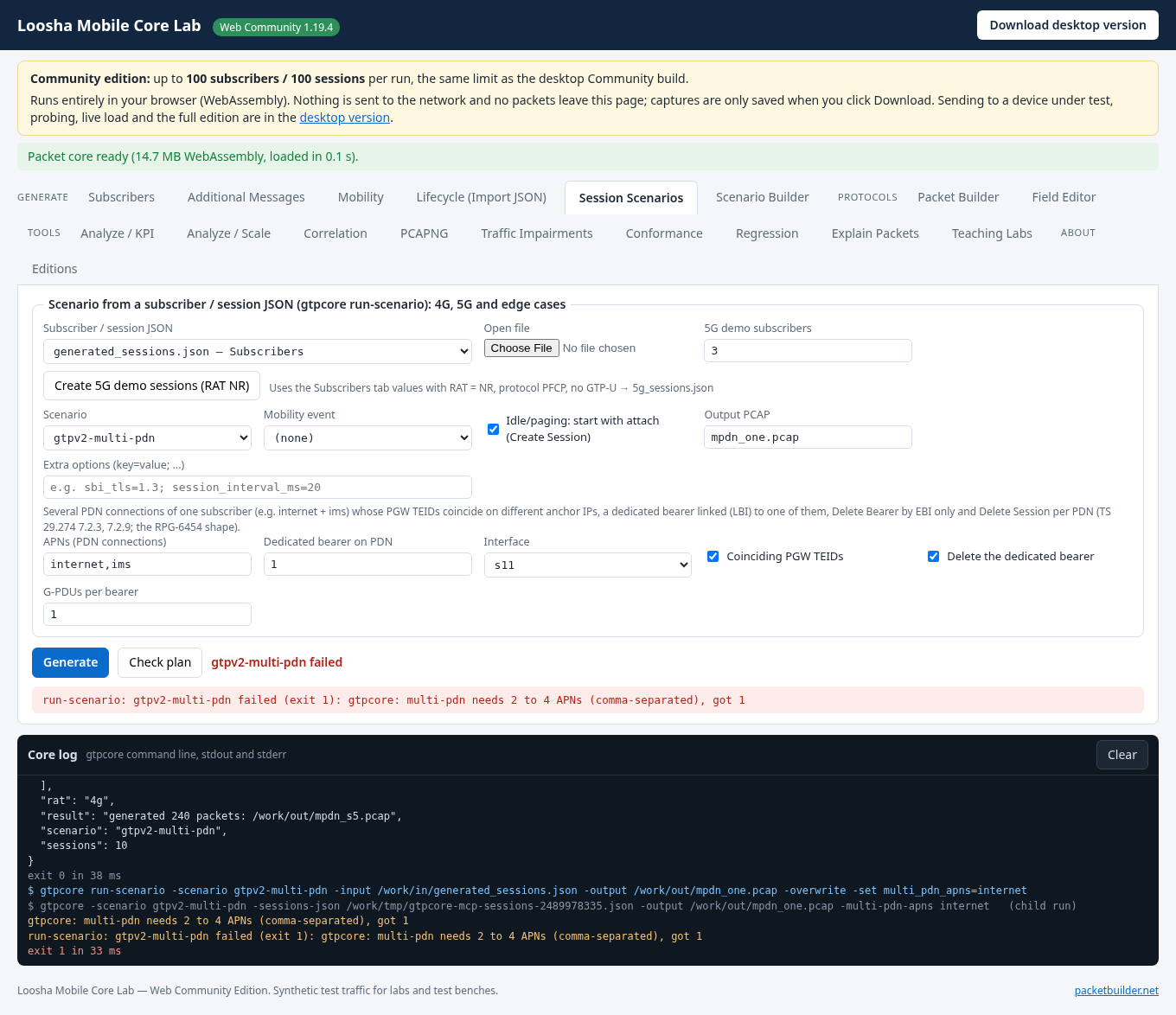
The same generation works in the browser Community edition; download the PCAP afterwards. GTP Sessions itself is a desktop tool — the web UI does not include it.
Community Edition caps a job at 100 subscribers/sessions. From 1.19.4 the generator also keeps per-PDN GTPv2 sequence numbers distinct when you ask for eight or more subscribers, so later PDN connections are not mistaken for retransmissions of earlier ones.
What the session tracker should show
Since 1.19.4, gtpcore sessions (Tools > GTP Sessions, and the MCP tools sessions_list / session_details / violations) attributes every request on a shared S11 tunnel to its PDN connection by LBI or EBI:
- one session per PDN connection, not one session per IMSI or per control TEID;
- the dedicated bearer is listed in the session of its LBI, with
linked_ebi, and is shown in the GUI asEBI (LBI n)— for example7 (LBI 5); - the shared S11 tunnel is not reported as
teid_collision.
Two violations catch actual procedure errors:
unknown_lbi— the Linked EPS Bearer ID is not a default bearer of the UE (TS 29.274 §7.2.3);ebi_in_use— a Create Bearer Response assigns an EBI that is already active (TS 29.274 §7.2.4).
You can also inject the EBI-reuse case with the edge-cases scenario (ebi-reuse). From an assistant, scenario_catalog with search=LBI returns the matching scenarios and toggles.
A practical workflow
- Start from a compact LTE session JSON. One IMSI is enough.
- Generate
gtpv2-multi-pdnwith two or three APNs, and point the dedicated bearer at PDN 2 if you want the harder case (multi_pdn_dedicated=2). - Open the PCAP in Tools > GTP Sessions, or run
gtpcore sessions -input mpdn.pcap -json sessions.json. Confirm one session per APN, the dedicated bearer under the LBI you chose, and noteid_collisionfor the shared tunnel. - Optionally turn
multi_pdn_teid_collisionoff and compare: the LBI still decides the PDN; only the uniqueness of the PGW TEIDs changes. - If you are checking your own analyser, feed it the same file and see whether it agrees.
Editions
Mobile Core Generator has a Community Edition, free for non-commercial evaluation, learning and compact lab scenarios (up to 100 subscribers/sessions, with send-to-network capped at 1000 packets/s). The Full Edition is a one-time $89 license. It removes those limits and adds response matching (probe) and a conformance suite with HTML/JSON reports. The current release is 1.19.4. It runs on Windows 10/11 64-bit, and a Linux build is available upon request. Session tracking in Community reports the first 100 sessions in detail.
Explore Mobile Core Generator →
FAQ
Does a shared S11 TEID mean a collision?
No. Additional PDN connections of the same UE reuse the existing S11 control tunnel. Since 1.19.4 the tracker does not raise teid_collision for that. A collision is an F-TEID announced again while another live session still owns it.
Why does Delete Bearer have no F-TEID?
The scenario can send a Delete Bearer Request that identifies the dedicated bearer only by EPS Bearer ID, which is a legal form of the message. Attribution then depends on EBI, not on a tunnel IE.
Can I try this in the browser?
Yes. You can generate gtpv2-multi-pdn in the Web Community edition. To inspect LBI attribution, download the PCAP and open it in the desktop GTP Sessions view or with gtpcore sessions.
Is this the same as many UEs under load?
No. An earlier article covers scale towards a lab UPF or SGW. This one is about several PDN connections of one IMSI, and about getting the dedicated bearer into the right PDN.